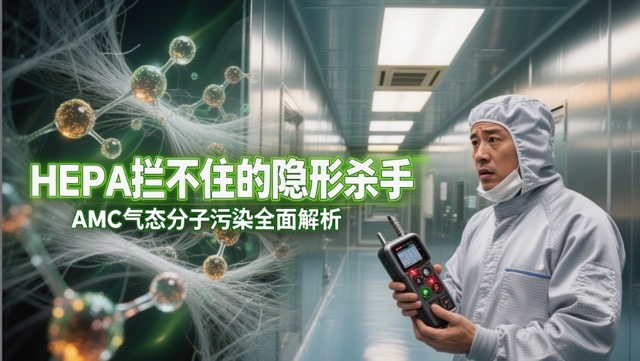
Last month, the quality director of an SMT factory in the Pearl River Delta called me.
"Mr. Liang, our cleanroom has met ISO Class 7 standards every year. We replace HEPA filters every six months, and our particle counter readings look perfect. But yield keeps falling — from 96% last year down to 89% now. Equipment vendors came four times and said the machines are fine. The environmental testing company came too and said particles are within spec. What on earth is going wrong?"
I asked him one question: "Have you ever tested for airborne molecular contaminants in your air?"
Five seconds of silence on the other end.
"What are airborne molecular contaminants?"
This isn't just his confusion. Among the hundreds of industrial cleanroom clients we've served in the Pearl River Delta, over 60% have fallen into the same trap — spending a fortune building a cleanroom, achieving airtight particle control, yet watching yield mysteriously decline.
The root cause hides in three letters: AMC.
AMC Control in Cleanrooms: The Invisible War Nobody Talks About
AMC stands for Airborne Molecular Contamination — chemical pollutants present in cleanroom air at the molecular level.
Unlike visible particles such as dust, skin flakes, and fibers, AMC consists of individual molecules or molecular clusters. They are extremely small, ranging from 2Å to 30Å — roughly one-millionth the diameter of a human hair.
What does this mean?
The HEPA or ULPA filters you spent hundreds of thousands installing are completely ineffective against AMC. The thermal energy of AMC molecules far exceeds the van der Waals forces between them and filter fibers, with adhesion coefficients as low as 10⁻³ to 10⁻⁵. In other words, AMC passes through all your physical filtration defenses like a ghost.
According to the SEMI F21 standard from SEMI (Semiconductor Equipment and Materials International), AMC is classified into four categories:
MA (Molecular Acids) — hydrogen fluoride, hydrogen chloride, sulfur oxides, nitrogen oxides. They corrode metal interconnects and solder pads, slowly poisoning product lifespan.
MB (Molecular Bases) — ammonia and organic amines. The top enemy of lithography. They neutralize acid catalysts in chemically amplified photoresists, causing "T-topping" defects, and fog optical inspection lenses.
MC (Condensable Organics) — VOCs, siloxanes, phthalates. They condense into a hazy film on cooler wafer or optical surfaces, causing a sharp drop in pad surface energy and direct adhesion failure during printing and soldering.
MD (Dopants) — boron and phosphorus. They unintentionally alter the electrical characteristics of semiconductor devices. Ironically, the borosilicate glass fiber HEPA filters used in traditional FFUs are themselves a source of boron release.
Your HEPA filter stops the dust, but lets the real killers through.
AMC Contamination in SMT Shops: The "Mysterious" Yield Drops
Back to the question about the factory director. What was actually happening in his SMT shop? Our team conducted a 72-hour environmental diagnostic on-site, and the results shocked everyone.
Hidden Killer #1: The Reflow Oven as a "Toxic Gas Factory"
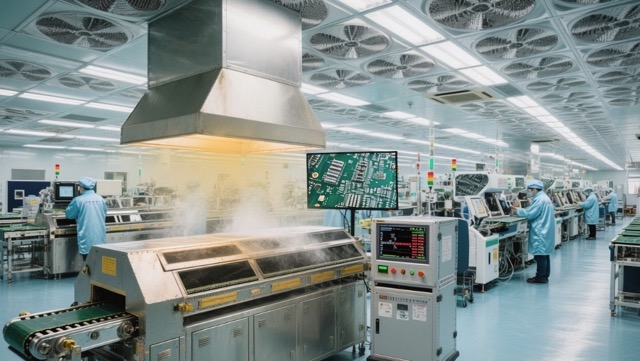
His shop consumed about 8 kg of solder paste daily. Modern SMT no-clean flux contains large amounts of solvents and activators. At reflow temperatures, nearly 4 kg of flux chemicals — hydrocarbons, rosin, organic acids — evaporate inside the oven every day.
If these vapors aren't promptly extracted and purified, they condense on PCBs, stencils, and even the precision optical alignment systems of pick-and-place machines.
We measured VOC concentrations at the reflow oven outlet at 12 times the normal level.
"No wonder our solder paste printing keeps having problems," he said, suddenly understanding. "It wasn't the paste — it was the air."
Hidden Killer #2: Ammonia from Personnel Breathing
An adult exhales and releases approximately 50–100 micrograms of ammonia per hour through breathing and skin. His shop had 35 operators working three shifts.
We measured NH₃ concentrations of 28 ppb near the optical inspection stations. That sounds small, but for precision optical systems, it's enough to form a thin layer of ammonium salt crystals on lens surfaces — which is why his AOI equipment kept "false-rejecting." It wasn't false rejection; the lenses were simply fogged.
Hidden Killer #3: The HEPA Filter Itself Was "Poisoning" the Air
This was the most ironic finding.
The FFU system he was so proud of used traditional borosilicate glass fiber HEPA filters. Under continuous airflow, these filters slowly release trace amounts of boron — an MD-class molecular dopant.
For semiconductors and precision electronics, boron causes unintended P-type doping, altering device electrical characteristics. His products weren't chip-level, but some high-end PCB assemblies are equally sensitive to boron contamination.
The "protection" he paid for had become a contamination source.
Chemical Filtration for AMC: Why Traditional Solutions All Fail
You might ask: now that we know the problem, can't we just install better filters?
It's not that simple.
Traditional ventilation and physical filtration are completely ineffective against AMC. The reason is straightforward — AMC is molecular-level. It's not a "particle," so you can't "sieve" it out.
Activated carbon can adsorb some large-molecule VOCs, but it's a reversible reaction. When temperature rises, adsorbed contaminants desorb and release back into the air. In Guangdong summers, a slight temperature fluctuation can turn an activated carbon filter from a "purifier" into a "releaser."
More critically, acidic gases (MA) and alkaline gases (MB) require chemical reactions to be removed — physical adsorption alone is insufficient.
This is why many companies upgrade their filtration systems and see little improvement — they're solving the wrong problem.
Cleanroom Chemical Filters: The Real Weapon Against AMC
Controlling AMC requires chemical filtration technology — a completely different approach from physical filtration.
Physical Adsorption + Chemical Adsorption: A Dual Approach
Physical adsorption: High-quality granular activated carbon (GAC) uses van der Waals forces to adsorb large-molecule VOCs and condensable organics (MC class). Relatively low cost, suitable for high-volume organic vapor treatment. Note: this is a reversible process requiring periodic media replacement.
Chemical adsorption: Ion exchange resins or media impregnated with specific reagents (such as potassium permanganate) react irreversibly with acidic gases (MA) and alkaline gases (MB), forming stable compounds with very high removal efficiency. This is the core weapon against AMC.
Catalytic Cracking: The "Antidote" for Reflow Ovens
For the large volumes of flux volatiles released by reflow ovens, the most effective solution is catalytic cracking technology.
The principle is straightforward: extracted heated oven air passes through a catalyst at up to 500°C, breaking long-chain hydrocarbon molecules into harmless carbon dioxide and water vapor.
Results are immediate — equipment maintenance intervals extend from a few days to 6+ weeks, and cross-contamination in the shop is eliminated at the source.
PTFE Filter Cleanrooms: The End of "Filter Poisoning"
Remember the boron release problem from the HEPA filters?
The solution: replace all traditional glass fiber filters with e-PTFE (expanded polytetrafluoroethylene) membrane filters.
PTFE is a chemically inert material containing no boron and no releasable chemicals. Its advantages are clear:
- True "zero boron" release, completely eliminating MD-class secondary contamination
- Acid and alkali resistant, longer lifespan in chemical environments
- Lower airflow resistance — FFU energy consumption reduced by 15–25% at equivalent filtration efficiency
- No compromise on filtration efficiency — ≥99.999% for 0.1μm particles
For semiconductor, optical, and precision electronics manufacturing, PTFE filters aren't an "upgrade option" — they're a requirement.
Cleanroom Yield Improvement: Keyao's Three-Layer Molecular Defense System
After serving hundreds of industrial cleanroom clients in the Pearl River Delta, Guangdong Keyao has developed a validated "Three-Layer Molecular Defense System".
Layer 1: Fresh Air Interception — Stop AMC at the Door
Large-scale AMC chemical filtration modules are installed at the fresh air handling unit (MAU) intake, intercepting SOx, NOx, VOCs, and other pollutants from outdoor industrial exhaust and vehicle emissions.
The Pearl River Delta is a manufacturing hub with dense surrounding factories, making external AMC input far higher than inland regions. This layer is the "moat" of the entire system.
Layer 2: Recirculation Purification — Continuously Remove Internal Sources
Chemical filtration sections are added to the recirculating air handling unit (RAU), continuously purifying AMC generated inside the shop — ammonia from personnel, VOCs from processes, and off-gassing from equipment and building materials.
This layer is the "standing guard," operating 24/7 to keep internal AMC concentrations below safe thresholds at all times.
Layer 3: Targeted Point Protection — "Micro-Environments" at Critical Stations
FFUs with chemical filters are installed above the most sensitive equipment — solder paste printers, reflow oven inlets, optical inspection stations, lithography machines — creating independent "mini-environments."
This layer is the "personal bodyguard," providing ppb or even ppt-level protection at critical workstations.
Three layers combined, from outside to inside, from coarse to fine — a complete molecular-level defense.
What Happened to the Factory Director's Shop?
We implemented a complete AMC control retrofit for his SMT shop over 6 weeks:
Weeks 1–2: Diagnosis and Solution Design
- 72-hour comprehensive AMC environmental testing, identifying three major pollution sources
- Delivered an AMC Contamination Diagnosis and Retrofit ROI Analysis Report
- Finalized a phased retrofit plan
Weeks 3–4: Phase 1 — Reflow Exhaust Purification + PTFE Filter Replacement
- Catalytic cracking purification system installed on reflow ovens
- All FFU filters replaced from glass fiber to e-PTFE membrane
- Result: VOC concentration dropped 82%, boron release fell below detection limit
- Yield recovered to 93%
Weeks 5–6: Phase 2 — Chemical Filtration System Deployment
- Chemical filtration modules added to MAU fresh air intake
- Chemical adsorption section added to RAU recirculation unit
- Chemical filtration FFU micro-environments deployed at critical stations
- Result: All AMC metrics met SEMI F21 standard requirements
- Yield stabilized at 97.2%
Data at Month 3 Post-Retrofit:
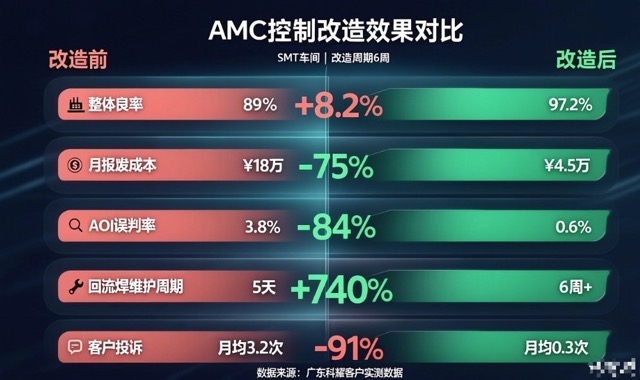
| Metric | Before | After | Change |
|---|---|---|---|
| Overall Yield | 89% | 97.2% | +8.2% |
| Monthly Scrap Cost | ~¥180K | ~¥45K | -75% |
| AOI False Rejection Rate | 3.8% | 0.6% | -84% |
| Reflow Maintenance Interval | 5 days | 6 weeks+ | +740% |
| Customer Complaints | 3.2/month | 0.3/month | -91% |
He told me afterward:
"We spent half a year looking for the cause in equipment, in process parameters, in operator behavior. We never imagined the real culprit was invisible molecules in the air. If we'd known about AMC earlier, we could have saved at least ¥1 million."
Is AMC Stealing Yield from Your Cleanroom?
If your cleanroom shows any of these symptoms, AMC may be the hidden cause:
- Particle counts pass, but yield keeps declining or fluctuating
- Optical inspection equipment frequently "false-rejects" or lenses fog up
- Solder adhesion mysteriously drops, cold joint rate rises
- Reflow ovens require frequent cleaning and maintenance
- Unknown films or discoloration appear on PCB surfaces
- Products fail reliability testing under high temperature and humidity
These problems can't be solved by replacing equipment, adjusting process parameters, or adding more HEPA filters.
Because the enemy isn't dust — it's molecules.
Guangdong Keyao: 13 Years in Cleanroom Engineering, Pearl River Delta AMC Control Experts
Guangdong Keyao Purification Electromechanical Engineering Co., Ltd., founded in 2012, is a council member of the Guangdong Province Cleanroom Industry Association. With 10+ technical patents, we have provided cleanroom environment solutions to over 100 enterprises including CR Sanjiu, Tomson By-Health, Haolai Chemical, Yangtze River Pharmaceutical, and Guangdong Provincial Second People's Hospital.
We focus on three core areas:
Industrial Cleanrooms — new energy, PCB, electronics, optics, food and packaging, biopharmaceuticals, medical devices
Medical Cleanrooms — operating rooms, ICUs, laboratories, pathology departments, CSSD, reproductive centers, and more
Laboratory Cleanrooms — chemistry labs, biology labs, PCR labs, animal facilities, constant temperature and humidity labs
13 years deep in the Pearl River Delta — from Foshan to Guangzhou, from Shenzhen to Dongguan. 2-hour response, 48-hour preliminary diagnosis.
🎁 Limited Offer: Free AMC Contamination Diagnostic Assessment
We're offering the first 10 companies in the Pearl River Delta who inquire:
- Free on-site AMC environmental testing (valued at ¥12,000): 2 senior engineers on-site, AMC Contamination Diagnostic Report delivered within 72 hours
- Custom retrofit plan + ROI analysis (valued at ¥8,000): 3 budget options with payback period calculations
- Industry benchmark case studies (valued at ¥5,000): Data from 3 similar companies' AMC retrofits, with option to visit reference sites
Total value ¥25,000 — available free for a limited time.
📊 Project Results Showcase
📞 Contact Us
Phone (fastest): 13929950401 Monday–Saturday, 9:00–18:00
WeChat (most convenient): Follow the "广东科耀" official account, reply "AMC诊断" for 1-on-1 engineer response, usually within 5 minutes
Website: www.gdforyou.com
Every month of delay means continued yield losses from AMC accumulating. The lesson is clear: finding it six months earlier saves at least ¥1 million.
Guangdong Keyao Purification Electromechanical Engineering Co., Ltd. | 13 Years in Cleanroom Engineering | Pearl River Delta Cleanroom Environment Solution Experts