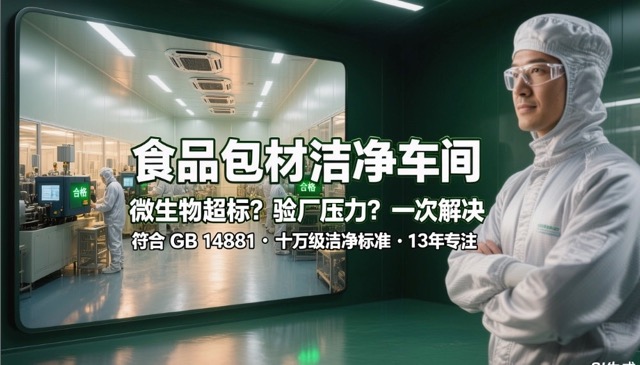
Focused on the full production environment for plastic containers, packaging films, meal boxes, and blister products — ensuring microbial control, foreign matter prevention, and food safety compliance.
The Night Before the Audit
The auditor arrives at 9 a.m. tomorrow.
Engineer Chen stared at the ceiling tiles, counting the dusty panels, wondering: should we stay late tonight and wipe them down?
Their factory had been supplying a leading fast-food brand for three years. Every year at this time was the hardest. Not the equipment, not the process — just that moment when the auditor pushes open the workshop door.
What if airborne bacteria counts are over the limit? What if there's a mosquito in the corner? What if the auditor asks about the gowning procedure and the workers can't answer?
Anyone in the food packaging business knows this anxiety.
You don't make food — but your products touch food directly. Meal boxes, packaging films, blister trays — every item that leaves your factory ends up in a consumer's takeout bag, parcel, or refrigerator. Downstream food and beverage clients and restaurant chains have near-exacting requirements for your production environment.
The question is: does your workshop actually meet the standard?
Why Ordinary Workshops Can't Pass Audits
Many food packaging factories look like this: a standard industrial building with a few floor-standing air conditioners, plain concrete or tile floors, regular suspended ceilings, and square-edged wall corners. Workers change into work clothes, wash their hands, and that's considered "clean."
Five years ago, that might have been enough. Not anymore.
Audit standards from major food and beverage clients have been tightening rapidly. More and more brands now require suppliers to meet ISO Class 7 (100,000-class) cleanroom standards, provide third-party airborne bacteria test reports, document gowning procedures, and design workshops with separated personnel and material flows.
An ordinary workshop simply cannot pass.
What does failing an audit mean?
At best, a three-month corrective action window. At worst, immediate removal from the approved supplier list. A major client's annual order can be worth millions. Once lost, it's gone.
Three Hidden Losses in Ordinary Workshops
Many factory owners think: nothing major has gone wrong, so we'll make do.
But "nothing major" doesn't mean "no losses." Ordinary workshops generate three types of hidden losses every day:
Loss 1: Rejected Goods Due to Microbial Contamination
Summer heat and humidity are the hardest season for food packaging factories. Without positive pressure protection or HEPA filtration, airborne microbial concentrations spike with temperature and humidity. Meal boxes stored in a client's warehouse for just one week can develop mold spots.
Once a client detects excess colony counts, you face a full-batch return. 200,000 meal boxes, a direct loss of 300,000 RMB, plus a suspension of supply pending corrective action — this isn't hypothetical. It happened to a meal box factory in East China.
Loss 2: Customer Complaints from Foreign Matter
Hair, insects, metal shavings — these are the unwelcome visitors food packaging factories fear most. Without air showers or positive pressure protection, people come and go freely, and insects fly in unchecked.
Every foreign matter complaint is a PR crisis. Once a consumer files a complaint with regulators and the media picks it up, years of brand trust can collapse overnight.
Loss 3: Unstable Print Quality and Rework Costs
Printing and lamination processes for food packaging are extremely sensitive to temperature and humidity. Temperature fluctuations reduce ink adhesion; humidity instability causes laminated films to bubble or delaminate. The same order can come out with inconsistent color depth and misaligned registration.
A 15% rework rate sounds low? On a production line with monthly output worth 2 million RMB, that's 300,000 RMB in wasted capacity and materials every month — 3.6 million per year.
Add up all three losses. How much profit is your ordinary workshop quietly consuming each year?
Your Competitors Have Already Acted
This isn't alarmism.
Leading food packaging enterprises in the Pearl River Delta and Yangtze River Delta have been upgrading their production environments intensively over the past two years. Their logic is simple:
- One cleanroom renovation eliminates audit pressure for a decade
- Microbial pass rates rise from 85% to 99.8%, eliminating return losses
- A cleanroom test report gives you confidence with clients — and justifies higher pricing than competitors
While you're still watching, they've already converted environmental advantages into order advantages and pricing power.
How much time do you have left?
The Complete Cleanroom Solution for Food Packaging Workshops
The good news: this problem is entirely solvable — without tearing everything down or halting production for months.
Guangdong Keyao Purification Electromechanical Engineering Co., Ltd. has focused on cleanroom engineering for 13 years, providing food-safety-grade cleanroom solutions for the food packaging industry. We deeply understand the special nature of food packaging as the "first line of defense for consumable products," and we know the real pressures every packaging factory faces during audits.
Our solution addresses the three core risks in food packaging production:
Dual Defense Against Microbes and Foreign Matter
Air purification is the first line of defense. We use a three-stage filtration system (pre-filter + medium-efficiency + HEPA), with HEPA filters achieving 99.99% filtration efficiency for particles and microorganisms >= 0.5μm. The clean zone maintains positive pressure (10–15 Pa) against adjacent areas, preventing external contamination from entering.
Key processes are equipped with UV or ozone sterilization. Personnel must pass through an air shower before entering the clean zone, cutting off all contamination pathways.
Food-Grade Design to GB 14881 / ISO 22000 Standards
We design workshops strictly in accordance with China's General Hygiene Standard for Food Production (GB 14881) and ISO 22000 requirements.
Workshop layout follows the principle of "separated personnel and material flows, zoned by cleanliness." Walls, ceilings, and floors use dust-free, corrosion-resistant, easy-to-clean materials. All internal corners are rounded to eliminate hygiene dead zones. Every detail stands up to an auditor's magnifying glass.
Constant Temperature and Humidity for Print and Lamination Quality
The printing and lamination zone features high-precision temperature and humidity control (23±2°C, 50±5% RH), ensuring stable ink performance and full crosslinking of lamination adhesives.
Color inconsistency, misregistration, film bubbling — the print quality problems that have plagued you for years are solved at the source.
Real Case Study: An East China Meal Box Factory's Transformation
Numbers speak louder than words.
Client background: A large East China manufacturer of disposable meal boxes, supplying multiple well-known restaurant chains. Quality Director Chen led this renovation project.
The Situation Before Renovation
The original workshop was a standard industrial building with no cleanroom treatment.
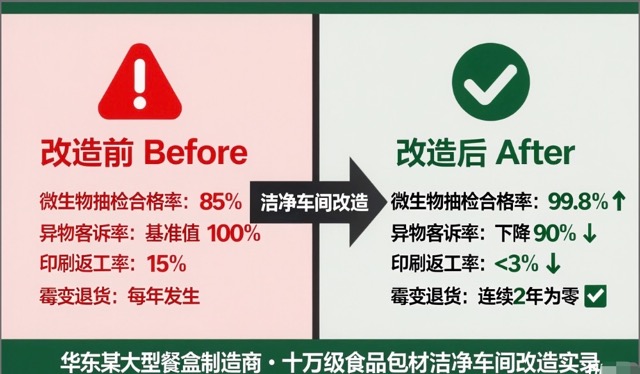
In the summer of 2023, meal boxes developed mold spots after one week in a client's warehouse. A leading fast-food brand returned an entire batch — 200,000 meal boxes, a direct loss of 300,000 RMB — and suspended the supply relationship pending corrective action.
At the same time:
- Occasional insect and hair contamination complaints required significant time and resources to address
- During a client audit, inspectors flagged dusty ceiling tiles, dirty floor joints, and inadequate gowning procedures, demanding corrective action within three months or removal from the approved supplier list
- Uncontrolled temperature and humidity in the printing workshop caused large color variations and repeated rework, frequently delaying delivery
"Back then, I dreaded every call from a client," said Engineer Chen.
Keyao's ISO Class 7 Food Packaging Cleanroom
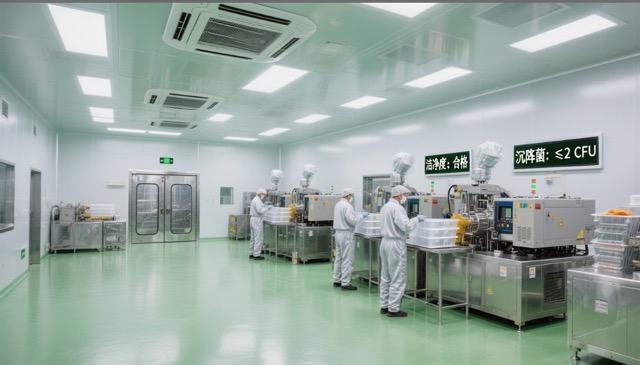
We designed and built a 100,000-class food packaging cleanroom compliant with GB 14881, implementing a "three-zone, two-corridor" layout, deploying a three-stage air filtration system, establishing a complete personnel gowning process, and achieving constant temperature and humidity control in the printing and lamination zone.
Results After Renovation
| Metric | Before | After |
|---|---|---|
| Microbial sampling pass rate | 85% | 99.8% |
| Mold-related returns | Occurred annually | Zero for two consecutive years |
| Foreign matter complaint rate | Baseline | Down 90% |
| Print rework rate | 15% | Below 3% |
| On-time delivery rate | — | Up to 98% |
At a recent audit by a leading tea beverage brand, inspectors gave high praise to both the cleanroom hardware and management systems.
Engineer Chen's company was upgraded from a backup supplier to a core strategic supplier.
Why Choose Keyao?
13 Years of Focus, 100+ Clients Validated
Guangdong Keyao Purification Electromechanical Engineering Co., Ltd. was founded in 2012. With over 13 years of cleanroom engineering experience, 100+ clients served, and 10+ technical patents, we are a council member of the Guangdong Cleanroom Industry Association.
Deep Expertise in Food Safety and Audit Standards
We understand the specific requirements of GB 14881 and ISO 22000 for production environments, and we know every checkpoint in major food and beverage client audits. Our designs are benchmarked against audit standards from day one.
EPC Turnkey — One-Stop, Worry-Free
From design, procurement, and construction to acceptance and after-sales, Keyao handles everything. No coordinating multiple vendors. No disputes over interfaces. One point of contact for everything.
Local in South China, Fast Response
Headquartered in Nanhai, Foshan, covering core Pearl River Delta cities. Response within 2 hours, preliminary on-site survey within 48 hours.
Four-Step Method for Building a Food-Safety-Grade Cleanroom
Step 1: Scientific Zoning — "Three Zones, Two Corridors"
Divide the workshop into three zones:
- Clean Production Zone: Core processes — molding, printing, lamination, packaging
- Semi-Clean Zone: Auxiliary processes — raw material unpacking, mixing
- General Work Zone: Non-production areas — warehouse, maintenance
The clean zone maintains positive pressure (10–15 Pa) against adjacent zones. Personnel and material flows are strictly separated; materials pass through transfer windows to prevent cross-contamination.
Step 2: Air Purification — Three-Stage Filtration
The 100,000-class clean zone uses a three-stage filtration air handling unit. HEPA filters achieve >= 99.99% filtration efficiency for particles >= 0.5μm. Airflow follows a top-supply, side-low-return pattern — clean air flows through the product zone first, then carries contaminants to the exhaust.
Step 3: Surface Hygiene — Rounded Corners, No Dead Zones
Walls, ceilings, and floors use cleanroom panels, epoxy self-leveling, and other dust-free, corrosion-resistant, easy-to-clean materials. All internal corners are rounded; floor-wall junctions use coved skirting; equipment bases are sealed to the floor. Lighting uses flush-mounted cleanroom light panels — flat surfaces, easy to wipe.
The corners auditors love to inspect simply don't exist in our workshops.
Step 4: Personnel Control — Four-Layer Gowning Protocol
Standard gowning sequence: shoe change → outer clothing removal → handwashing and disinfection → cleanroom suit → hand disinfection → air shower → enter clean zone. Sinks feature touchless faucets and automatic soap dispensers. Air showers have interlocked doors to prevent bypassing.
Cleanroom behavioral standards are incorporated into daily training and assessments, making every employee a guardian of food safety.
Is It Time for Your Workshop's "Health Check"?
If any of the following applies to you:
- ✅ A major client audit is coming up and you're worried about your production environment
- ✅ You've had microbial contamination returns or foreign matter complaints
- ✅ Print and lamination quality is unstable with persistently high rework rates
- ✅ A client has asked for a cleanroom certification report and you don't have one
- ✅ You're planning to build or expand a food packaging production line
Then it's time to seriously consider a professional food packaging cleanroom renovation.
Guangdong Keyao offers a free on-site survey service:
- 2 senior engineers visit your facility for a comprehensive environmental assessment
- We issue a Food Packaging Workshop Cleanroom Renovation Feasibility Report
- We provide a renovation plan and budget reference compliant with GB 14881
- We can arrange visits to completed food packaging cleanroom showcase projects
Contact Keyao to get started:
☎️ Phone: 13929950401
WeChat: Follow the "广东科耀" official account or scan the QR code below to add WeChat

Website: www.gdforyou.com
📊 Project Results Showcase
About Guangdong Keyao
Guangdong Keyao Purification Electromechanical Engineering Co., Ltd. — 13 years focused on cleanroom engineering, 100+ clients served, 10+ technical patents.
Three core domains: Industrial Cleanrooms (food packaging, biopharma, medical devices, electronics/optics, etc.), Medical Cleanrooms (operating theaters, ICUs, labs, CSSD, etc.), Laboratory Cleanrooms (PCR labs, animal facilities, physical/chemical labs, constant temperature/humidity labs, etc.).
Council Member, Guangdong Cleanroom Industry Association | Guangdong "Contract-Honoring, Credit-Worthy" Enterprise | Professional Contractor Qualification for Building Decoration
No place for microbes to grow. No place for foreign matter to hide. That is our promise for every food packaging cleanroom we build.