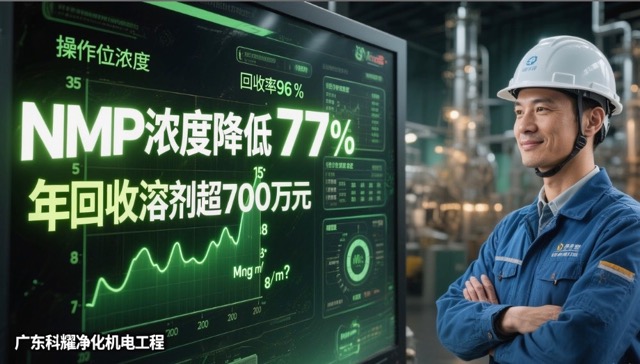
For engineering/safety/environmental managers of lithium battery cell manufacturing plants
The 2 AM Phone Call
When Engineer Li, the coating workshop director at a power battery plant in East China, received this call, it was already 2 AM.
"The environmental bureau is coming for inspection tomorrow morning."
He hung up the phone, stood at the workshop entrance, smelling that familiar, pungent odor, knowing clearly: this time, it probably won't pass.
Inside the workshop, a dozen coating machines were running. NMP vapor drifting from the oven inlets and outlets was faintly visible under the lights. Workers wore masks, but those masks provided almost no protection against NMP vapor.
This scene plays out every day in lithium battery factories across the Pearl River Delta and Yangtze River Delta.
1. Occupational Health Protection in Coating Processes: An Underestimated Time Bomb
NMP, short for N-Methylpyrrolidone, is the core solvent for lithium battery cathode and anode slurry preparation.
It has strong volatility with a boiling point of 202°C, but in the high-temperature environment of coating ovens, large amounts of NMP vapor escape into the workshop air from oven inlets/outlets, coater heads, and other locations.
National occupational health standards clearly stipulate: The MAC limit for NMP in workplace air is 20mg/m³.
But what's the reality?
Among the lithium battery factories we've served, over 70% of coating workshops have NMP concentrations at operator positions consistently hovering between 30~60mg/m³, with some workshops even exceeding 80mg/m³—four times the national limit.
Workers' reactions are the most direct signals:
- "After two years on the job, my checkup showed some liver function issues."
- "I get dizzy after work every day. I thought it was fatigue, later learned it was NMP."
- "Experienced workers in the workshop leave in batches. New hires come, work a few months, then leave."
This isn't an isolated case. This is the concentrated outbreak of the industry's long-term debt in occupational health protection for coating processes.
2. NMP Purification in Lithium Battery Coating Workshops: Three Pressures Mounting Simultaneously
Engineer Li's dilemma isn't just an environmental inspection problem.
He's facing three mountains pressing down at once.
The First Mountain: Occupational Health Compliance Pressure
After the revision of the "Occupational Disease Prevention and Control Law," corporate responsibility has been significantly strengthened. Once an employee is diagnosed with an occupational disease, the company not only faces huge compensation but may also have its production license revoked.
NMP has been included in the "Classification Catalog of Occupational Hazard Factors." Workers in coating workshops, exposed to exceeding-standard environments for 8 hours daily, are sitting on a legal bomb that could explode at any moment.
The Second Mountain: Environmental Inspection and Emission Compliance Pressure
In recent years, ecological environment departments across various regions have become increasingly strict in controlling VOCs unorganized emissions from lithium battery manufacturing enterprises.
NMP falls under the VOCs (Volatile Organic Compounds) control category. Exceeding standards for unorganized emissions at factory boundaries or emission outlet concentrations can result in rectification fines at minimum, or production restrictions and shutdowns at worst.
Engineer Li's factory received two rectification notices in the past year alone.
The Third Mountain: The Hidden Cost of NMP Solvent Loss
Many factory management teams only see the first two mountains and overlook the third.
NMP market prices range between 15,000~20,000 yuan/ton. A coating production line with annual capacity at the GWh level consumes hundreds of tons of NMP annually.
Without an effective NMP exhaust gas recovery system, this solvent is discharged with exhaust gas, lost in vain.
Engineer Li calculated: their factory's annual NMP loss exceeds 8 million yuan.
"That money, just drifted away." When he said this, there was an indescribable helplessness in his tone.
3. MAC Limit Control Workshops: Why "Installing a Few Exhaust Fans" Won't Solve the Problem
Many factories' first reaction is to increase ventilation.
Install a few more axial fans to "blow away" the odor.
This approach isn't completely wrong, but it doesn't solve the fundamental problem.
Reason 1: Dilution is Not Capture
Increasing ventilation volume only dilutes NMP vapor before discharging it outdoors. On one hand, factory boundary emission concentrations may still exceed standards; on the other hand, while NMP concentrations in the workshop may decrease somewhat, workers' actual exposure in "high concentration areas" like coater heads and oven inlets/outlets hasn't significantly improved.
Reason 2: Without Source Capture, Ventilation Efficiency is Extremely Low
NMP vapor escape follows patterns—mainly concentrated at a few points: coater heads and oven inlets/outlets. If local enclosed exhaust hoods aren't installed at these points, and instead relying on overall ventilation "flooding," the required air volume is 5~10 times that of precision capture solutions, with extremely high energy consumption but much worse results.
Reason 3: Without Recovery, Solvent Loss Cannot Be Reversed
Simple ventilation discharge means NMP is discharged directly into the atmosphere with exhaust gas. This not only wastes valuable solvent resources but also increases the difficulty of end-stage treatment.
Reason 4: Unable to Achieve MAC Limit Precision Control
Without online concentration monitoring, there's no way to know the actual NMP concentration at various workshop points. Management's control over the workshop environment is completely in a "blind flying" state.
This is why many factories install exhaust systems, but workers still get dizzy, and environmental inspections still don't pass.
4. Organic Exhaust Gas Treatment in Coating Workshops: Delaying Will Only Increase Costs
We've seen too many cases of "delaying."
Factory that delayed 8 months: After two consecutive rectification notices from environmental authorities, the third time brought direct production restrictions. During the shutdown rectification period, over 12 million yuan in orders were lost, key customers turned to competitors and never returned.
Factory that delayed 1 year: An experienced worker in the coating process was diagnosed with occupational chemical poisoning. Corporate compensation plus work stoppage rectification caused direct losses exceeding 3 million yuan, with immeasurable indirect reputational damage.
Factory that delayed 2 years: Cumulative NMP solvent loss exceeded 16 million yuan. This amount would be enough to build a complete NMP exhaust gas recovery system, with half left over.
The cost of delaying is never "let's wait and see"—it's paying real costs every single day.
Have You Calculated This Account?
Most factory management only sees "exhaust fan electricity costs" without calculating the true losses:
| Loss Type | Annual Estimate | Description |
|---|---|---|
| NMP solvent direct discharge loss | 3~8 million yuan | Depends on production line scale |
| Environmental fines and rectification costs | 500k~2 million yuan | Including shutdown losses |
| Employee turnover and recruitment costs | 300k~1 million yuan | High turnover in coating processes |
| Occupational disease compensation risk | Potentially millions | Once occurred, immeasurable |
| Total | Starting from 4 million yuan | Annually, continuously lost |
While a complete NMP coating workshop exhaust gas treatment system typically requires investment of 1.5~4 million yuan, with a payback period not exceeding 18 months.
This isn't a cost—it's an investment.
5. NMP Exhaust Gas Recovery System: Keyao's Comprehensive Solution
The good news is: this problem can be completely solved systematically.
After serving multiple lithium battery cell manufacturing enterprises in South China and East China, Guangdong Keyao Purification & Mechanical Engineering Co., Ltd. has developed a battle-tested "Precision MAC Control Type" NMP Coating Purification Workshop Comprehensive Solution.
The core logic in one sentence: Capture NMP vapor before it escapes, recover it before exhaust gas discharge, and precisely monitor it throughout the entire process.
5.1 Source Capture: The First Line of Defense for NMP Solvent Recovery Equipment
Targeting major escape points like coater heads and oven inlets/outlets, Keyao designs customized local enclosed exhaust hoods, combined with push-pull airflow organization, ensuring NMP vapor is effectively captured before escaping.
Key parameters:
- Capture efficiency > 95%
- CFD fluid dynamics simulation to optimize hood shape and wind speed
- Does not interfere with coating process, does not affect product quality
5.2 Airflow Organization: Core Design for MAC Limit Control Workshops
Designating the coating area as a "key control zone," maintaining slight negative pressure (-5~-10Pa) relative to adjacent areas.
Supply air uses top-supply bottom-return mode, fresh air first flows through the operator's breathing zone, then carries contaminants into exhaust outlets, forming directional flow. Eliminating eddies and dead zones, ensuring the entire workshop's NMP concentration is uniformly controlled, with operator position concentrations stably below the MAC limit of 20mg/m³.
5.3 Exhaust Gas Purification: Two-Stage Condensation + Zeolite Rotor Adsorption NMP Recovery Process
High-concentration NMP exhaust gas is concentrated and enters a "two-stage condensation + zeolite rotor adsorption concentration" treatment system:
- First-stage condensation: Uses low temperature to liquefy high-concentration NMP for direct recovery
- Second-stage condensation: Further cools uncondensed gas to improve recovery rate
- Zeolite rotor adsorption: Adsorbs and concentrates low-concentration tail gas, then desorbs and re-condenses
NMP recovery rate can reach over 95%, recovered solvent can be directly reused in production batching, with tail gas meeting discharge standards.
5.4 Intelligent Monitoring: Online NMP Concentration Monitoring and Linked Control
Installing NMP online concentration sensors at key points like workshop operator areas and discharge outlets, with data transmitted in real-time to the central control system.
The system sets multiple thresholds:
- Warning value: Automatically increases exhaust volume
- Alarm value: Sound-light alarm + linked recovery enhancement
- Exceedance linkage: Automatically adjusts operating parameters, records historical data
Management can view concentrations at each point at any time, with historical data supporting production batch traceability and environmental performance assessment.
6. Real Case: NMP Concentration Reduced from 35 to 8mg/m³, Annual Solvent Recovery Worth 7 Million Yuan
Let the data speak.
Client Background: A leading power battery enterprise in East China, coating workshop director Engineer Li (the same person mentioned at the beginning of this article).
True Situation Before Retrofit
- Workshop used traditional top-supply bottom-exhaust, no local capture
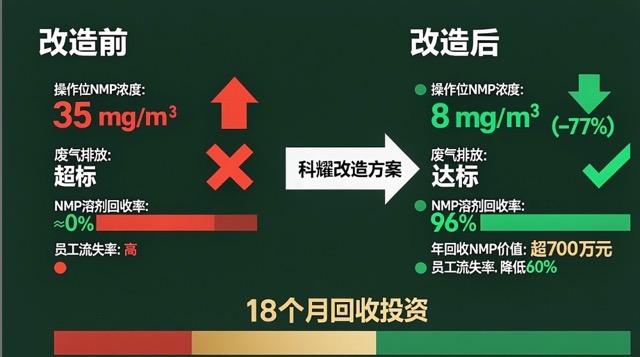
- Operator position NMP concentration average: 35mg/m³ (1.75 times national standard)
- Multiple employees resigned due to physical discomfort, high turnover rate
- Factory boundary unorganized emissions repeatedly exceeded standards, received rectification notices
- Annual NMP solvent loss: over 8 million yuan
Keyao Retrofit Plan and Implementation
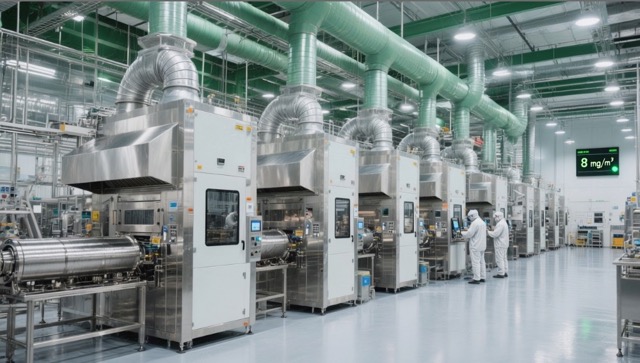
Keyao designed and built a brand new NMP coating purification workshop, including:
- Coater head + oven inlet/outlet local enclosed capture system
- Full workshop slight negative pressure airflow organization retrofit
- Two-stage condensation + zeolite rotor NMP recovery equipment
- Full-point online concentration monitoring and intelligent linkage platform
Data Results After Retrofit
| Indicator | Before Retrofit | After Retrofit | Improvement |
|---|---|---|---|
| Operator position NMP concentration average | 35mg/m³ | 8mg/m³ | Reduced by 77% |
| Exhaust gas outlet VOCs concentration | Exceeded standard | Stably below 30mg/m³ | Successfully passed environmental acceptance |
| NMP solvent recovery rate | Nearly zero | 96% | — |
| Annual recovered NMP value | 0 | Over 7 million yuan | — |
| Employee turnover rate | High | Reduced by 60% | — |
| Investment payback period | — | About 18 months | — |
Engineer Li later said something that left a deep impression on us:
"Before, I was on edge every time there was an environmental inspection. Now, I wish they'd come more often."
7. Four-Step Method for Lithium Battery Workshop Clean Engineering: Building MAC-Compliant NMP Coating Purification Workshops
This methodology is the experience summary from Keyao's 13 years serving 100+ clients in lithium battery, medical, laboratory, and other industries.
Step 1: Source Capture—Designing Efficient Enclosed Exhaust Systems
Targeting key escape points like coater heads and oven inlets/outlets, customized design of "local enclosed hood + push-pull airflow" capture devices.
Through CFD fluid dynamics simulation to optimize hood shape and wind speed, ensuring capture efficiency > 95%, while avoiding interference with coating processes.
This is the first line of defense for controlling workshop concentrations, and the most critical step.
Step 2: Airflow Organization—Building "Slight Negative Pressure + Directional Flow" Workshop Environment
Designating the coating area as a "key control zone," maintaining slight negative pressure (-5~-10Pa) relative to adjacent areas.
Supply air uses top-supply bottom-return mode, fresh air first flows through the operator's breathing zone, then carries contaminants into exhaust outlets, forming directional flow. Through reasonable arrangement of supply and exhaust outlets, eliminating eddies and dead zones, ensuring the entire workshop's concentration is uniformly controlled.
Step 3: Exhaust Gas Purification—Implementing "Condensation Recovery + End-Stage Treatment" Combined Process
High-concentration NMP exhaust gas first enters the condensation recovery unit, using low temperature to liquefy NMP for recovery; uncondensed gas enters zeolite rotor adsorption concentration, then is desorbed and re-condensed for deep purification.
The entire system operates automatically, recovered solvent can be directly reused for batching, tail gas meets discharge standards, satisfying the strictest environmental standards.
Step 4: Intelligent Monitoring—Deploying Online Concentration Monitoring and Linked Control Systems
Installing NMP concentration sensors at key points like workshop operator areas and discharge outlets, with data connected to the central controller.
The system sets multiple thresholds: warning, alarm, exceedance linkage. Once concentration approaches the warning value, automatically increases exhaust volume or adjusts recovery parameters; simultaneously records historical data, supporting production batch traceability and environmental performance assessment.
Intelligent control not only ensures safety but also optimizes energy consumption, achieving green operation.
8. What's the Current State of Your Coating Workshop?
If your workshop meets any of the following criteria, we recommend contacting us for a free diagnosis as soon as possible:
- ☑ Obvious NMP odor at operator positions, workers experience dizziness or nausea
- ☑ Received environmental rectification notices or complaints within the past year
- ☑ No online NMP concentration monitoring, unclear about actual workshop concentration
- ☑ NMP solvent consumption per unit remains high, no effective recovery means
- ☑ Currently planning new or expanded coating production lines
For the first 10 inquiring enterprises, we provide:
✅ Free on-site survey (2 senior engineers visit)
✅ 72-hour delivery of "Workshop NMP Environment Diagnosis Report"
✅ 3 retrofit plans at different budgets + ROI investment return calculation
📊 Project Results Showcase
About Guangdong Keyao Purification & Mechanical Engineering Co., Ltd.
13 Years of Focus on Clean Engineering | 100+ Clients Served
Guangdong Keyao Purification & Mechanical Engineering Co., Ltd., established in 2012, is a professional comprehensive solution provider for clean environment technology in South China.
Three Major Professional Fields:
- Industrial Clean: New energy (lithium batteries), PCB, electronics, optics, biopharmaceuticals, medical devices, and other clean workshops
- Medical Clean: Operating departments, ICU, laboratories, central sterile supply departments, and other special departments
- Laboratory Clean: PCR laboratories, animal facilities, physical and chemical laboratories, constant temperature and humidity laboratories, etc.
Qualifications and Honors:
- Council member of Guangdong Clean Room Industry Association
- Guangdong Province "Contract-honoring and Credit-worthy" Enterprise
- Guangdong Clean Room Industry "Excellent Construction Enterprise"
- Holds over 10 technical patents, 50+ professional solutions
Contact Us:
☎️ Phone: 13929950401
WeChat: Follow the "广东科耀" official account or scan the QR code below to add WeChat

Headquarters: Room 706, Building A, Phase 5, Tianan Cyber Park, No.1 Jianping Road, Guicheng Street, Nanhai District, Foshan City, Guangdong Province
Website: www.gdforyou.com
Keyao—Making NMP nowhere to hide, letting workers breathe with peace of mind.