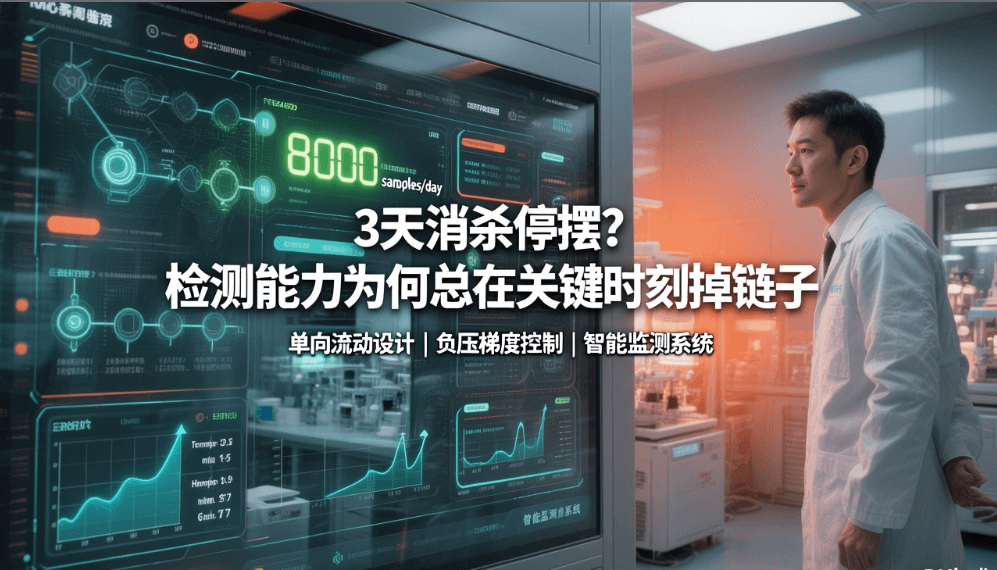
Speed vs Truth in PCR Labs: Winning the Hidden War Against Report Delays
At 2 AM, the phone rang for the laboratory director at a major hospital in South China.
It was the emergency department: "Director Wang, when will the PCR results be ready for that suspected severe infection patient? The family can't wait any longer, and we don't dare administer medication without confirmation..."
Director Wang glanced at the lab's surveillance feed—samples were lined up in the pre-processing area, three technicians scrambling around the biosafety cabinets. The PCR machines had finished their runs long ago; the samples just hadn't reached them yet.
"Give it another two hours," he said.
This scene has played out daily in laboratories across the country over the past three years.
The Misunderstood Bottleneck
Many people assume PCR testing is slow because there aren't enough instruments or staff.
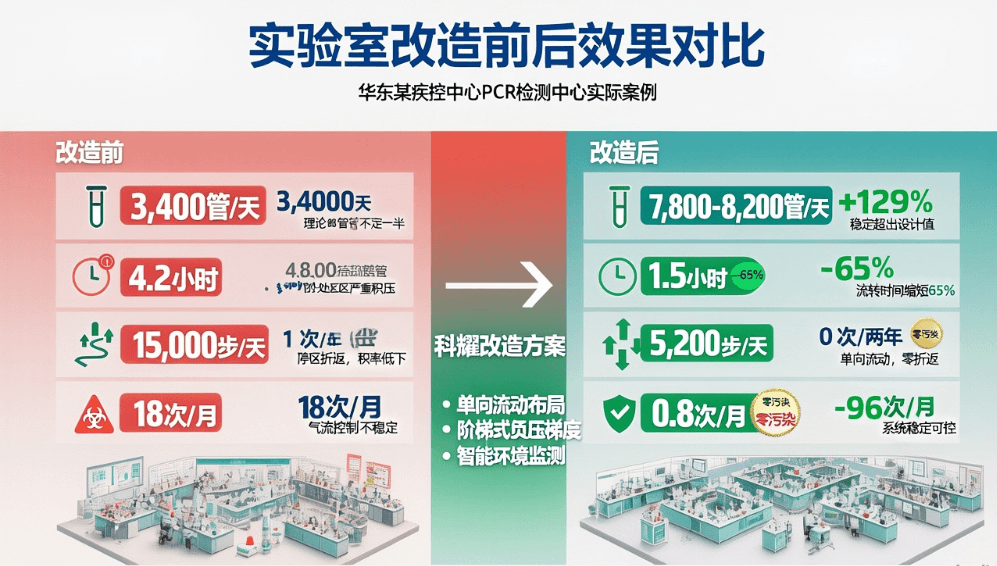
Last year, we conducted an assessment for a municipal CDC. They had purchased 8 imported PCR machines, theoretically capable of processing 8,000 samples per day. But actual output? Around 3,400 samples daily, reaching 3,700 on good days.
Where was the problem?
We spent three days with stopwatches. We found that samples waited an average of over 4 hours from receipt to loading onto machines. During those 4 hours, the PCR machines were essentially idle, waiting for work.
We then tracked one technician's movement patterns. From reagent preparation to sample loading, she shuttled back and forth between three zones dozens of times daily. Her fitness tracker showed over 15,000 wasted steps in the corridors.
Even more troubling were the risks from frequent personnel movement. In 2022, a medical testing laboratory in a provincial capital had an incident—due to poor airflow design, aerosols from amplification products contaminated the sample preparation area as staff moved about. The lab shut down for 5 days of decontamination, with over 20,000 samples backlogged, nearly causing a testing system collapse.
So the problem isn't equipment—it's workflow. It's space.
What Keeps Front-Line Managers Up at Night
If you're responsible for a lab planning to process over 5,000 samples daily, or one that handles public health emergencies, you understand—
The biggest anxiety is never about lacking a few more PCR machines.
It's about:
- Sample volumes spike, and the pre-processing area immediately bottlenecks with queues at biosafety cabinets
- Technicians running between zones, unable to improve efficiency while contamination risks rise
- Slight airflow control issues can cause incidents, and incidents mean shutdown for decontamination
- When testing capacity fails at critical moments, all the pressure falls on you
These problems can't be solved by overtime or adding staff.
They require fundamental redesign.
Designing Labs Like Logistics Centers
Traditionally, we designed PCR labs using "three-zone" or "four-zone" functional divisions—like simply placing a warehouse, workshop, and packaging room side by side.
But high-throughput testing is actually more like a logistics system—each sample is cargo, each operation is a process step, and every movement path affects efficiency and safety.
Over the years, we've developed an approach that boils down to three things:
Layout: Implement Unidirectional Flow
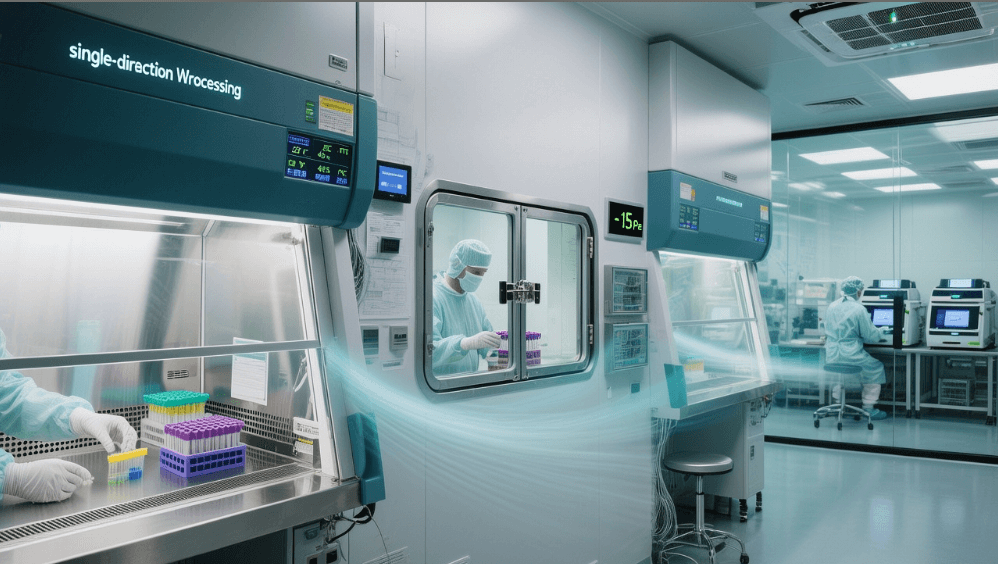
Don't let people and samples backtrack. Arrange reagent preparation, sample preparation, and amplification analysis zones in a straight line or U-shape. Connect zones with double-door interlocking pass-through windows, allowing samples and materials to flow only one direction, eliminating the need for personnel to cross zones.
It's like converting congested city streets into highways—no traffic lights, no turning back.
Airflow: Establish Negative Pressure Gradients
Air must flow from clean zones toward contamination-risk zones, never the reverse.
The sample preparation zone is especially critical—implement directional supply and exhaust ventilation to create an "air curtain" that contains and rapidly removes potential aerosols. This system is invisible but cannot fail.
Operations: Rely on Data Monitoring
Install IoT environmental monitoring to watch pressure differentials, temperature, humidity, and cleanliness across all zones 24/7. Alarms trigger immediately when pressure differentials become unbalanced. Data is stored in the cloud, ready to generate environmental traceability reports for CMA/CNAS certification at any time.
Transform human vigilance into technological protection.
A Real Case Study
The microbiology testing laboratory at a CDC in East China approached us.
Their lab used traditional parallel three-zone design. It worked fine normally, but once sample volumes exceeded 3,000, the pre-processing area started queuing, with wait times exceeding 4 hours during peak periods. Technicians were exhausted from corridor marathons, yet efficiency remained low.
What worried the director most was a contamination incident—airflow cross-contamination led to amplification product contamination, requiring 3 days of decontamination shutdown.
We spent over two months refining the renovation plan. The final design included:
- Converting to unidirectional linear layout with all samples moving through pass-through windows, no cross-zone personnel movement
- Establishing stepped negative pressure gradients with intelligent pressure differential monitoring and alarms
- Integrating environmental data with LIMS for full-process visualization
The results after renovation?
| Metric | Before | After |
|---|---|---|
| Sample Transit Time | 4+ hours | Reduced by 60%+ |
| Daily Testing Throughput | 5,000 samples (design capacity) | 7,800-8,200 samples (stable) |
| Contamination Incidents | Occasional | Zero incidents for 2 years |
| Pressure Differential Alarms | Frequent | Significantly reduced |
The director later said something at an industry conference that stuck with me:
"Before, people were fighting against the workflow. Now, the workflow helps people work faster."
Where Is Your Lab Right Now?
- Sample backlogs, delayed reports, constant complaints
- Staff exhausted but efficiency still won't improve
- Worried about airflow contamination but lacking effective monitoring
- Want to expand or upgrade but don't know where to start
If you're experiencing these problems, it might be time to take a fresh look at your workflow design.
Guangdong Keyao has been doing cleanroom engineering for 13 years, serving numerous CDCs, hospital laboratories, and third-party medical testing institutions. From design to construction to acceptance, we've encountered many pitfalls and accumulated considerable experience in cleanroom environment construction for microbiology and PCR laboratories.
Our understanding is that an efficient PCR lab isn't just about stacking equipment—it's about precise workflow orchestration.
Let's Talk
Whether you're planning a new lab or optimizing an existing one, we can start with a conversation:
- Lab workflow diagnosis to identify optimization opportunities
- How to design cleanliness and pressure differential systems more effectively
- What CMA/CNAS certification requires for environmental conditions
These initial consultations are free.
Professional problems need professional solutions.
Speed is life. Reports can't wait.
Project Results Showcase
Contact Us
Guangdong Keyao Purification & MEP Engineering Co., Ltd. 13 Years Focused on Cleanroom Engineering
Headquarters: Room 706, Building A, Phase 5, Tian'an Cyber Park, No. 1 Jianping Road, Guicheng Street, Nanhai District, Foshan City, Guangdong Province Hotline: 13929950401
13 Years Focused on Cleanroom Engineering | 100+ Successful Cases | 10+ Technical Patents