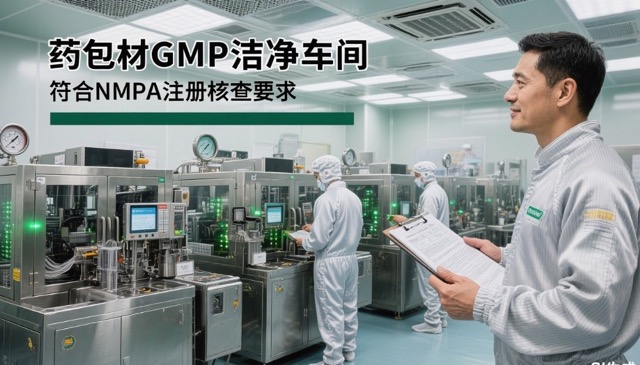
The "Three Fatal Threats" Facing Pharmaceutical Plastic Bottle Cleanrooms
Manager Zhao received the call at 2:30 in the afternoon.
It was the quality director of his biggest client — a well-known oral liquid pharmaceutical company in North China.
"Mr. Zhao, we can't accept this batch. Pre-filling inspection found microbial limits exceeded. 2 million bottles — all returned."
After hanging up, Zhao sat in his office and did the math: 2 million bottles, direct loss of 600,000 RMB. Worse, the client announced a six-month suspension of cooperation.
Six months. The workshop still had to run, wages still had to be paid, equipment depreciation kept ticking.
That wasn't even the worst of it.
Three months later, a provincial drug regulatory inspection team arrived unannounced. They walked through the workshop twice and produced a long list of deficiencies: inadequate personnel purification facilities, cross-contamination risks in material transfer, no dynamic environmental monitoring…
The final line made Zhao's blood run cold: "Rectify within the deadline, or your pharmaceutical packaging registration certificate will be revoked."
That certificate had taken him three years and millions of RMB to obtain.
There was one more thing he hadn't told anyone. The company had developed a new eye drop bottle product — a perfect opportunity to enter the ophthalmic drug market. But when a pharmaceutical client came to audit the facility, they took one look at the workshop and said: "Your production environment doesn't meet Class C cleanroom standards. This partnership can't move forward."
Just like that, a market window worth potentially tens of millions in annual sales closed right in front of him.
This isn't just Zhao's story.
Among the pharmaceutical packaging manufacturers we've served, over 70% have experienced at least one of these situations: microbial exceedance returns, regulatory inspection rectifications, or being shut out of premium pharmaceutical supply chains due to substandard facilities.
The root cause is one thing — ordinary injection molding workshops cannot meet GMP compliance requirements for pharmaceutical packaging.
You Think It's Just "Return Losses" — It's Far More Than That
Many pharmaceutical packaging business owners treat microbial exceedance returns as a one-off quality incident — swap the raw material batch, increase disinfection, resubmit for testing.
But that's just treating the symptom. The real cost compounds across four layers, each heavier than the last.
Layer 1: Visible Direct Losses
- Return and destruction losses: 2 million bottles per batch means 600,000 RMB minimum
- Shutdown rectification costs: fixed costs keep running during forced shutdowns — easily hundreds of thousands per month
- Re-testing fees: environmental testing and microbial limit testing costs stack up
Layer 2: Cascade Effects of Failing Registration Inspection
With NMPA's linked review and approval system now fully implemented, pharmaceutical packaging registration inspections are no longer a formality. Expert teams focus squarely on the production environment:
- Does the cleanroom classification match the product registration category?
- Is the personnel purification process compliant?
- Is environmental monitoring data complete and traceable?
- Are pressure differentials and temperature/humidity continuously controlled?
Any non-conformance means at minimum a request for rectification and supplementary materials — at worst, delayed registration.
A new product's registration window is typically only 6–12 months. Miss it, and competitors have already launched while your product is still awaiting inspection feedback.
Layer 3: Supply Chain Exclusion Risk Under Linked Review Requirements
Pharmaceutical companies' supplier audits are no longer just "checking certificates." They send QA teams to your facility for item-by-item GMP verification:
- Does the cleanroom have an independent HVAC purification system?
- Is there online environmental monitoring data?
- Are personnel and material flows separated?
- Are complete cleaning and disinfection records maintained?
Fail any of these, and you're removed from the approved supplier list. Not suspended — permanently excluded.
Layer 4: What Happens If You Wait Another Year…
We've seen this too many times: a pharmaceutical plastic bottle company in South China kept delaying because "renovation costs are too high." A year later, two of their three core pharmaceutical clients had switched to competitors with GMP cleanrooms. The third explicitly stated in negotiations: complete the cleanroom renovation by year-end, or the contract won't be renewed.
Regulatory inspections don't give advance notice. Pharmaceutical client audits won't wait until you're ready. Can your workshop pass both right now?
GMP Cleanroom Solution: The Five-Step Construction Method
The good news: this problem can be solved systematically. Not by buying air purifiers or installing UV lamps — but by building a pharmaceutical plastic bottle cleanroom system that genuinely meets GMP requirements from the ground up.
After serving over 100 pharmaceutical and packaging companies, we've developed a Five-Step Construction Method validated through NMPA registration inspections.
Step 1: Compliant Layout — GMP Zone Design Based on Process Flow
Many cleanroom renovation projects fail at step one — get the layout wrong, and everything after is just patching.
A GMP-compliant pharmaceutical packaging workshop must be divided into three zones based on process flow:
- Clean Production Zone (injection molding, blow molding, washing, packaging): Core area, Class D or Class C
- Auxiliary Clean Zone (mold storage, material staging): Transition area
- General Zone (mixing, crushing): Non-clean area
Positive pressure gradients must be maintained between zones: clean zone vs. general zone ≥10 Pa; between different clean classifications ≥5 Pa.
Personnel and material flows must be separated: personnel route through changing room 1 → changing room 2 → handwashing/disinfection → buffer room; materials pass through self-purifying transfer windows or airlocks.
This layout must be reviewed by GMP experts to ensure compliance with registration inspection requirements.
Step 2: Air Purification — Validation-Grade HVAC Configuration
Correct configuration includes:
- Three-stage filtration: pre-filter + medium-efficiency + HEPA
- Air change rates meeting Class D (≥20 ACH) or Class C (≥40 ACH) requirements
- Supply air diffuser placement optimized via CFD (Computational Fluid Dynamics) simulation to eliminate dead zones
- Low-side return air to prevent secondary contamination
- Temperature/humidity control at 18–26°C, 45–65% RH to suit different plastic material processing requirements
The moment an injection mold opens, the cavity is exposed to air — the highest-risk moment for particle contamination. We install local laminar flow protection around injection molding machines specifically for this scenario.
Step 3: Process Media Purification — Compressed Air and Purified Water Systems
Compressed air: Compressed air that contacts products during injection molding must be equipped with multi-stage precision filtration (0.01μm oil/water/bacteria removal filters) to achieve sterile, particle-free standards. Industrial compressed air used directly in pharmaceutical packaging production is a major source of particle contamination.
Purified water system: Water used in final washing must meet Chinese Pharmacopoeia purified water standards. Using "pre-treatment + reverse osmosis + EDI" process, 316L stainless steel piping, circulating insulation design, and regular disinfection to prevent biofilm growth.
Getting these two systems right reduces particle and microbial contamination risk by over 80%.
Step 4: Environmental Monitoring — Combined Online/Offline Data Traceability System
Both regulatory inspections and pharmaceutical client audits will focus on one thing: where is your environmental monitoring data?
Our monitoring system deployed in cleanrooms includes:
- Online particle counters: Real-time monitoring of particle counts at critical dynamic locations
- Airborne microbial samplers: Regular sampling and culture, with recorded microbial data
- Temperature/humidity + pressure differential sensors: 24-hour real-time transmission to central monitoring system
All monitoring data is linked to production batch records, creating complete "environmental batch records". Any environmental anomaly triggers automatic alerts, traceable to the specific operating period.
This data is your strongest evidence during regulatory inspections and client audits.
Step 5: Validation Support — Full DQ to PQ Validation Services
Building the cleanroom is just the first step. Pharmaceutical packaging registration and client audits both require a complete GMP validation document package:
| Validation Phase | Content |
|---|---|
| DQ (Design Qualification) | Confirms design meets GMP requirements |
| IQ (Installation Qualification) | Documents equipment installation parameters |
| OQ (Operational Qualification) | Tests system operational stability |
| PQ (Performance Qualification) | Demonstrates environment continuously meets cleanroom standards |
We don't just build the facility — we deliver the complete validation documentation, ready for direct use in NMPA registration submissions and pharmaceutical client audits. This means you don't need to separately hire a validation company, and won't face registration delays due to incomplete validation materials.
Real Case Study: From Return Nightmare to Industry Benchmark
Back to Manager Zhao's story. He found us three weeks after receiving the regulatory rectification notice.
We conducted an on-site survey of his workshop: ordinary injection molding facility, no independent purification HVAC, no pressure differential monitoring, personnel and materials using the same entrance, raw material storage right next to injection molding machines. The problems weren't isolated — they represented a complete systemic absence of GMP infrastructure.
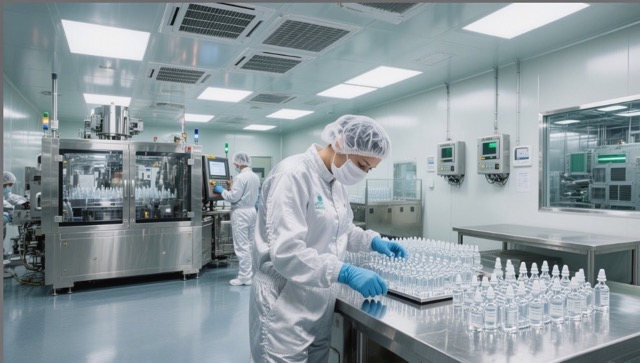
We designed and built a Class D GMP cleanroom for him, with a Class C upgrade interface reserved for the eye drop bottle production line.
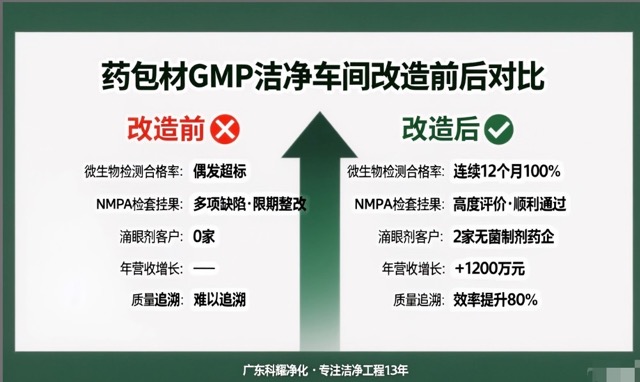
Data from 12 months post-renovation:
| Metric | Before | After |
|---|---|---|
| Microbial limit inspection pass rate | Occasional exceedances | 100% for 12 consecutive months |
| Regulatory inspection result | Multiple deficiencies, rectification required | Highly commended, passed smoothly |
| Eye drop bottle client access | 0 (facility substandard) | 2 sterile pharmaceutical companies |
| New annual revenue | — | 12 million RMB |
| Quality issue traceability efficiency | Difficult to trace | Improved by 80% |
Manager Zhao later told us:
"Before, I thought building a cleanroom was spending money. Now I understand — it's buying a ticket into the premium pharmaceutical supply chain."
Why Choose Keyao
Guangdong Keyao Purification Electromechanical Engineering Co., Ltd. — 13 years focused on cleanroom engineering.
We're not a general contractor. We're cleanroom environment specialists focused on the pharmaceutical and packaging industry:
- ✅ Deep GMP expertise: Familiar with GMP regulations and pharmaceutical packaging annexes — designs directly aligned with registration inspection requirements
- ✅ Full EPC turnkey service: Design → procurement → construction → acceptance → validation documents, all from one company
- ✅ Validation documents delivered with the project: Complete DQ/IQ/OQ/PQ package, ready for NMPA submissions and pharmaceutical client audits
- ✅ Local Pearl River Delta response: Rapid response across the Greater Bay Area, on-site project management throughout
- ✅ 100+ successful projects: Clients include CR Sanjiu, Yangtze River Pharmaceutical, and their packaging suppliers
Our core position: a pharmaceutical packaging cleanroom is not a cost — it's a pass into the premium pharmaceutical supply chain.
Get a Free Workshop Assessment
If you're facing any of these situations:
- Occasional microbial limit exceedances with no identifiable root cause
- Regulatory inspection or pharmaceutical client audit approaching, feeling unprepared
- Planning new product registration but uncertain whether your facility will pass inspection
- Looking to enter premium markets like eye drop bottles or injectable packaging requiring Class C environment
Contact us for a free preliminary GMP compliance assessment of your workshop. Send us your floor plan or basic facility information, and our engineers will provide an initial assessment and renovation recommendations within 48 hours.
📞 Phone: 13929950401
🌐 Website: www.gdforyou.com
📍 Address: Room 706, Block A, Phase 5, Tianan Digital City, No. 1 Jianping Road, Guicheng Street, Nanhai District, Foshan, Guangdong
WeChat: Follow the "广东科耀" official account or scan the QR code below to add WeChat
Follow the Keyao Purification official account and reply "pharmaceutical packaging" to receive:
- GMP Cleanroom Construction Standards Checklist for Pharmaceutical Packaging
- Environmental Validation Document Templates for Pharmaceutical Packaging Registration
- Class D/C Cleanroom Cost Reference Guide
📊 Project Results Showcase
Guangdong Keyao Purification Electromechanical Engineering Co., Ltd. | 13 Years of Cleanroom Excellence | Member of Guangdong Cleanroom Industry Association