
Semiconductor AMC Control: 5-Step Standard SOP Implementation
Comprehensive guide to AMC (Airborne Molecular Contamination) control, from source monitoring to HVAC system integration. 13 years of expertise solving chip yield and T-topping issues.
As semiconductor process nodes advance toward 5nm, 3nm, and even atomic scales, the paradigm of environmental control has shifted from "particle control" to "molecular-level chemical control." AMC (Airborne Molecular Contamination) has become the invisible killer affecting chip yield rates.
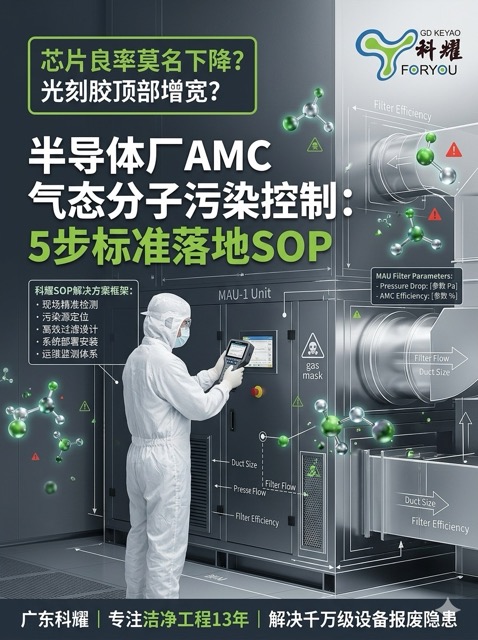
Mysterious chip yield decline? Photoresist T-topping? Server creep corrosion? These seemingly unrelated failures have a 90% chance of originating from improper AMC control. Today, Guangdong Keyao leverages 13 years of professional experience to provide you with a detailed breakdown of the 5-step standard SOP process for AMC control.
Step 1: Source Identification and Monitoring
The Four Destruction Categories of AMC
AMC refers to chemical substances that can penetrate traditional mechanical filters in molecular form and cause damage to products, process equipment, or sensitive surfaces through physical adsorption or chemical reactions. Unlike particle contamination, AMC effects are delayed, cumulative, and difficult to reverse.
The international semiconductor industry classifies AMC into four categories based on chemical properties and damage mechanisms:
| Type | Representative Substances | Damage Mechanism |
|---|---|---|
| 🔴 MA (Acidic) | HCl, HF, SO2, NOx | Metal interconnect micro-corrosion, optical lens clouding |
| 🔵 MB (Basic) | NH3, Amines, NMP | Photoresist T-topping, salt deposition |
| 🟡 MC (Condensable) | High-MW VOCs, Siloxanes | Optical transmittance decline, increased surface adhesion |
| 🟣 MD (Dopants) | Boron, Phosphorus, Arsenic | Transistor threshold voltage drift |
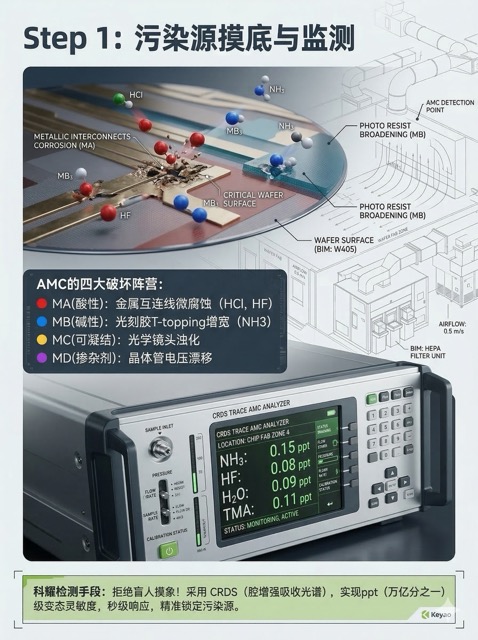
Keyao Detection Methods: No More Guessing
We employ CRDS (Cavity Ring-Down Spectroscopy) technology, where laser light makes thousands of round trips within an optical cavity, achieving an equivalent optical path length of several kilometers. This provides ppt (parts per trillion) level sensitivity with second-level response for NH3, HF, and SO2, unaffected by temperature and humidity.
AMC sources are diffuse and sudden, primarily including:
- External Infiltration: Urban traffic emissions of SOx, NOx, and VOCs with morning/evening peak variations
- Internal Generation: Ammonia and organic acids from personnel metabolism, organosilicon released from aging equipment seals
- Process Chemical Volatilization: Photoresist solvents (NMP, etc.), IPA used in cleaning processes
Step 2: Gas-Phase Filtration System Selection
Physical + Chemical Dual Interception
Ordinary mechanical filters are ineffective against AMC! A chemical equilibrium strategy must be employed, selecting appropriate filtration technologies for different contaminants.
Physical Adsorption: Utilizing van der Waals forces in activated carbon micropores to capture high molecular weight VOCs, suitable for efficient capture of low molecular weight gases.
Chemical Adsorption (Core Technology):
| Target Contaminant | Filtration Technology | Principle |
|---|---|---|
| Acidic gases (MA) | Impregnated alkaline substances | Acid-base neutralization |
| Basic gases (MB) | Citric acid-modified activated carbon | Chemical adsorption capture |
| Reducing gases (H2S) | Potassium permanganate oxidation | Redox reaction |
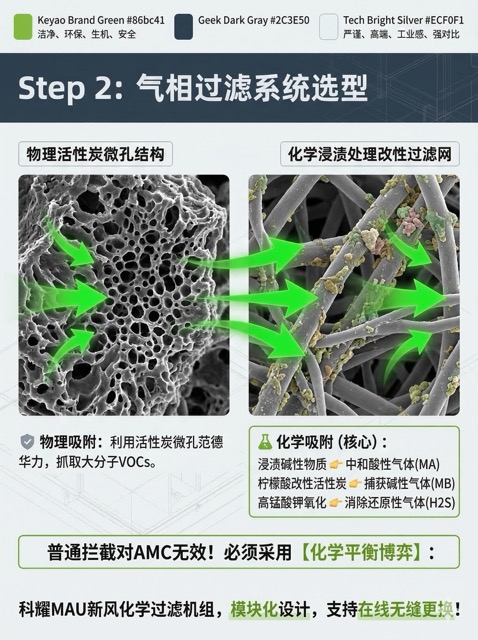
Keyao MAU Fresh Air Chemical Filtration Units feature modular design with online seamless replacement capability, ensuring production continuity. Multi-stage chemical filtration configurations can be flexibly adjusted based on actual monitoring data.
Step 3: Micro-Environment Control (FOUP Isolation)
The Ultimate Protection Chamber for Wafers
Full environment control too costly? Micro-environments are the last line of defense!
FOUP (Front Opening Unified Pod) Control Strategy:
- Store wafers in sealed containers
- Continuously purge with ultra-pure nitrogen (N2 Purge)
- Result: Reduce AMC exposure risk by over 90%
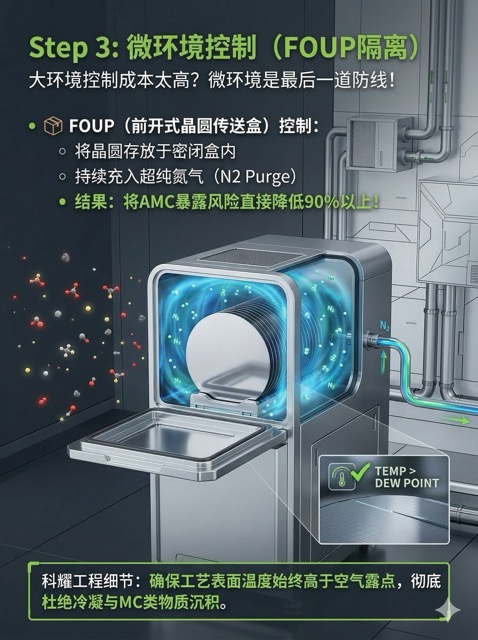
Keyao Engineering Details: Ensure process surface temperatures remain consistently above air dew point to completely eliminate condensation and MC-type substance deposition. In EUV lithography, high-energy radiation causes photochemical dissociation of residual organic molecules, with carbon atoms from dissociation products accumulating on mirror surfaces—every 1nm of carbon film significantly reduces reflectivity. Micro-environment control is the key measure to prevent such issues.
Step 4: HVAC System Synergy
Purification Without Understanding Aerodynamics Is Nonsense
HVAC system design and operation directly impact AMC control effectiveness, requiring meticulous attention to airflow organization and temperature/humidity control.
Temperature and Humidity Red Line Control:
Once relative humidity (RH) exceeds 60%, server "creep corrosion" increases exponentially! Sulfur-containing gases (such as H2S, SO2) react with copper/silver on circuit boards at moderate humidity, with corrosion products crawling along surfaces causing short circuits.
Keyao employs Reheat Dehumidification technology, locking in extremely high humidity stability while ensuring process surface temperatures remain above air dew point.
Airflow System Design Essentials:
- ✅ Recommended: CAV (Constant Air Volume System)
- ❌ Use with caution: VAV (Variable Air Volume System)
- ❌ Avoid: Economizers introducing large amounts of uncontrolled outdoor air
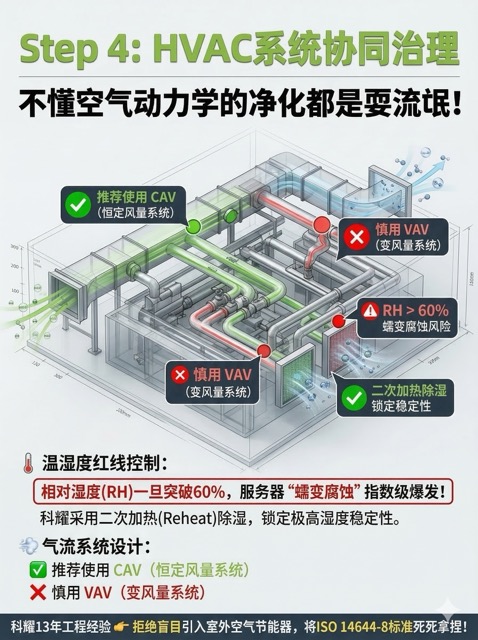
Keyao's 13 Years of Engineering Experience: Reject blind introduction of outdoor air economizers, master ISO 14644-8 standards thoroughly!
Step 5: International Standards and Continuous Optimization
Data-Driven AMC Management System
Establishing a complete AMC management system requires reference to the following international standards:
ISO 14644-8 (Cleanroom ACC Classification): From Class 0 (10^0 g/m³, ordinary office) to the stringent Class -12 (10^-12 g/m³, advanced lithography and EUV core areas).
ISA-71.04-2013 (Corrosion Environment Classification): Defines levels from G1 (mild, copper reaction rate < 300Å/30 days) to GX (extremely severe, conventional electronic equipment cannot survive).
2024 IRDS Roadmap: AMC control enters the "active yield management" phase, emphasizing moving monitoring points to "viable points in processing systems" and correlating key defect conditions through mathematical modeling.
Future Trends: Combining AI-driven global chemical environment simulation to achieve millisecond-level response to contamination events, and achieving high integration of efficient chemical treatment with ultra-low energy consumption HVAC systems.
Summary
AMC control is a systems engineering project requiring coordinated efforts across monitoring, filtration, micro-environment, and HVAC systems. With 13 years of professional experience, Guangdong Keyao provides you with:
- 🏆 Professional Team: Focused on clean engineering for 13 years, 10+ technical patents
- 🤝 Trusted by 300+ Enterprises: China Resources Sanjiu, Danzi Group, Southern Medical University, and more
- 📋 One-Stop Service: From diagnosis to solutions, from construction to operations, worry-free throughout
Guangdong Keyao — Understanding Process, Mastering Engineering
Contact Us for "AMC Control and Cleanroom Construction Whitepaper":
- Consultation Hotline: +86 139-2995-0401
- Headquarters: Room 706, Building A, Phase 5, Tianan Digital City, No. 1 Jianping Road, Nanhai District, Foshan City, Guangdong Province
Guangdong Keyao Purification & Electromechanical Engineering Co., Ltd. — Focused on clean engineering for 13 years, providing professional clean environment solutions for semiconductor, electronics, pharmaceutical, and other industries.